For me, a DNA test is not a “final answer” but another tool in family history research. It does not replace parish registers, archival records, or family stories – rather, it complements them, confirms them, and sometimes raises new questions.
Interpreting genetic results is particularly fascinating, but not always straightforward. Ethnicity estimates are not precise maps of ancestry; they are statistical models showing which present-day populations my DNA most closely resembles.
Ethnicity Estimates
Both MyHeritage and Ancestry indicate that my genetic background is primarily connected to Central and Eastern Europe.
The regions that appear most prominently include:
– Slovakia, Eastern Czechia, Hungary and Poland
– Germanic regions
– The Balkans
These results correspond remarkably well with the historical picture that emerges from traditional genealogical research. The Carpathian Basin has always been a multicultural region where Hungarians, Germans, Slovaks, South Slavs and many other communities lived alongside one another, often intermarrying across generations.
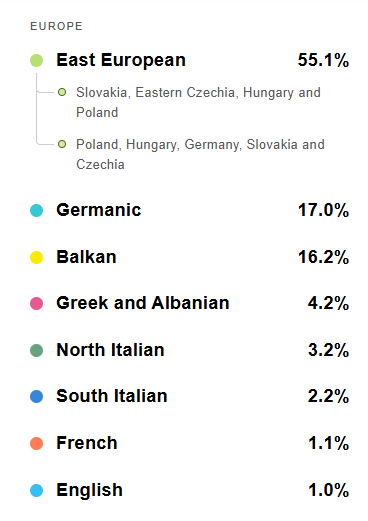
MyHeritage ethnicity estimate
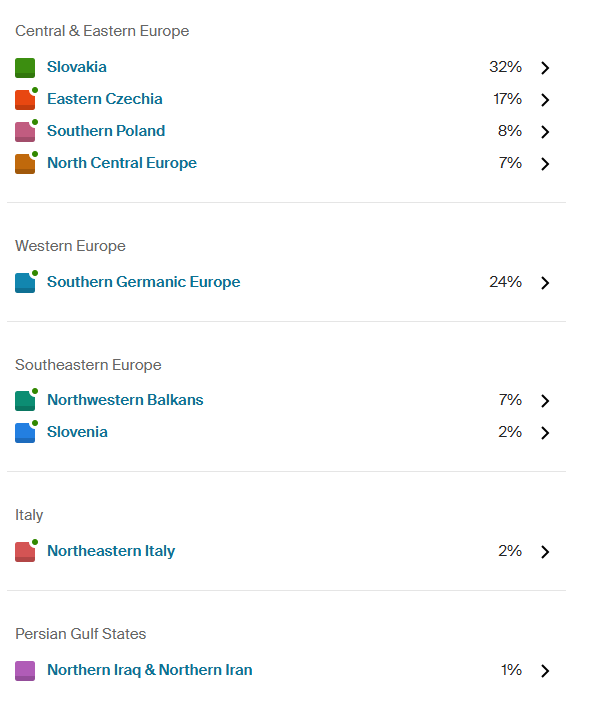
Ancestry ethnicity estimate
Parent Inheritance
Ancestry offers the possibility of separating ethnicity estimates into paternal and maternal contributions.
As neither of my parents has taken a DNA test, I assigned these groups myself based on my family history research.
This is not a “machine-generated truth” but a research-based interpretation. Using parish records, surnames and migration patterns, I identified which regions most likely belong to which parental branch.
In my view, this division is consistent with both the documentary evidence and the genetic results.
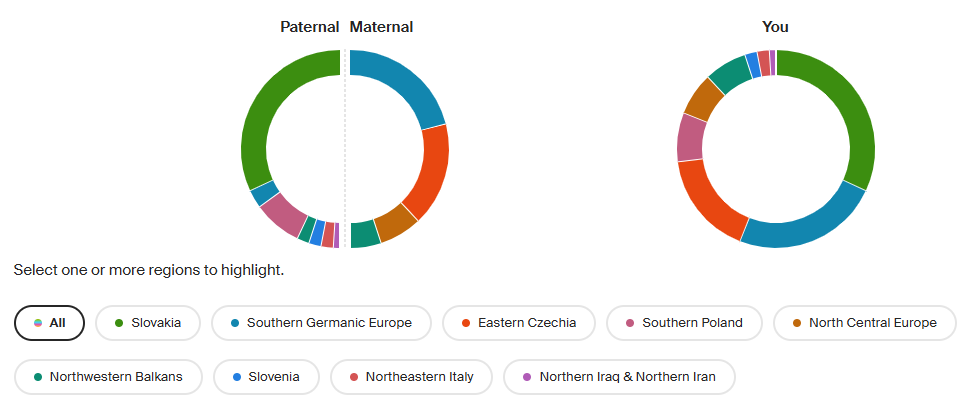
Ancestry – paternal and maternal regions, based on genealogical research
A Brief Overview of the Four Grandparental Branches
I always interpret DNA results through the lens of documented family history.
My Paternal Grandfather’s Branch
This branch currently presents a mixed picture.
On the one hand, there is a well-documented and stable line connected to the historical County of Trenčín.
Several Slovak families can be traced there through parish registers and multiple generations of documented relationships.
On the other hand, there are family names and origins that remain uncertain.
The earlier origins of the Soltész family before their appearance in Kunszentmiklós are still unknown, although both the surname and historical context suggest a possible German background.
In the case of the Meller family, a marriage record contains the notation “ex Prussia”, indicating an origin in Prussia and therefore most likely within the German-speaking world.
For me, this branch represents both established knowledge and unresolved questions: part of the story is already well understood, while another part remains an intriguing historical mystery.
My Paternal Grandmother’s Branch
This branch is strongly connected to the Southern Great Plain of Hungary, particularly the area around Szegvár, Szentes, Nagymágocs and Mindszent, as well as the town of Szarvas.
Here, the histories of Hungarian and partly Slovak families of Reformed, Roman Catholic and Lutheran backgrounds intertwine.
My Maternal Grandfather’s Branch
This branch is concentrated in Tolna and Somogy counties.
It includes both German (Danube Swabian) families and Hungarian Reformed families from settlements such as Diósberény, Hőgyész, Dombóvár, Kaposfő and Somogyjád.
My Maternal Grandmother’s Branch
Perhaps the most geographically and culturally diverse branch:
– Transylvania (Reformed families of the former County of Háromszék)
– The Banat region (German and Bulgarian families from Vinga)
– Baja and Baranya county (German settler families)
This branch illustrates particularly well how deeply interconnected the population history of Central and Southeastern Europe has been.
DNA Matches
DNA testing is important to me not only because of ethnicity estimates. Equally significant are DNA matches – people with whom I share identifiable segments of DNA.
I have found identifiable relatives on all four grandparental branches, including matches that could also be confirmed through parish records and genealogical research.
This provides valuable confirmation that traditional documentary research and genetic evidence point in the same direction. DNA does not replace archival work, but it can strengthen, complement and occasionally redirect it.
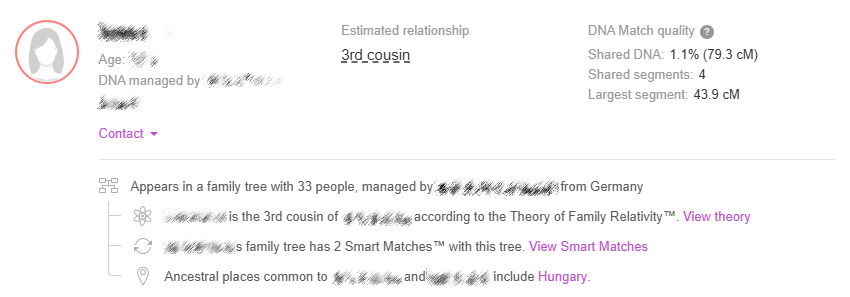
An example of a relationship confirmed through both documentary research and DNA evidence
What Does DNA Add to My Research?
For me, DNA is not a destination but a source of new questions.
It helps me:
– verify already documented family connections
– confirm historical conclusions
– identify branches that remain less well understood
Genetic results do not tell me who my ancestors were – that story is told by records, documents and family histories.
What DNA does show is that these stories truly live on within me.